EssayAI Capabilities and Trust
The More Fluent AI Sounds, the More Cautious You Should Be
AI is most dangerous not when it is obviously wrong, but when a false answer looks complete and credible. Managers need different rules for expression, judgment, and facts.
Original Chinese version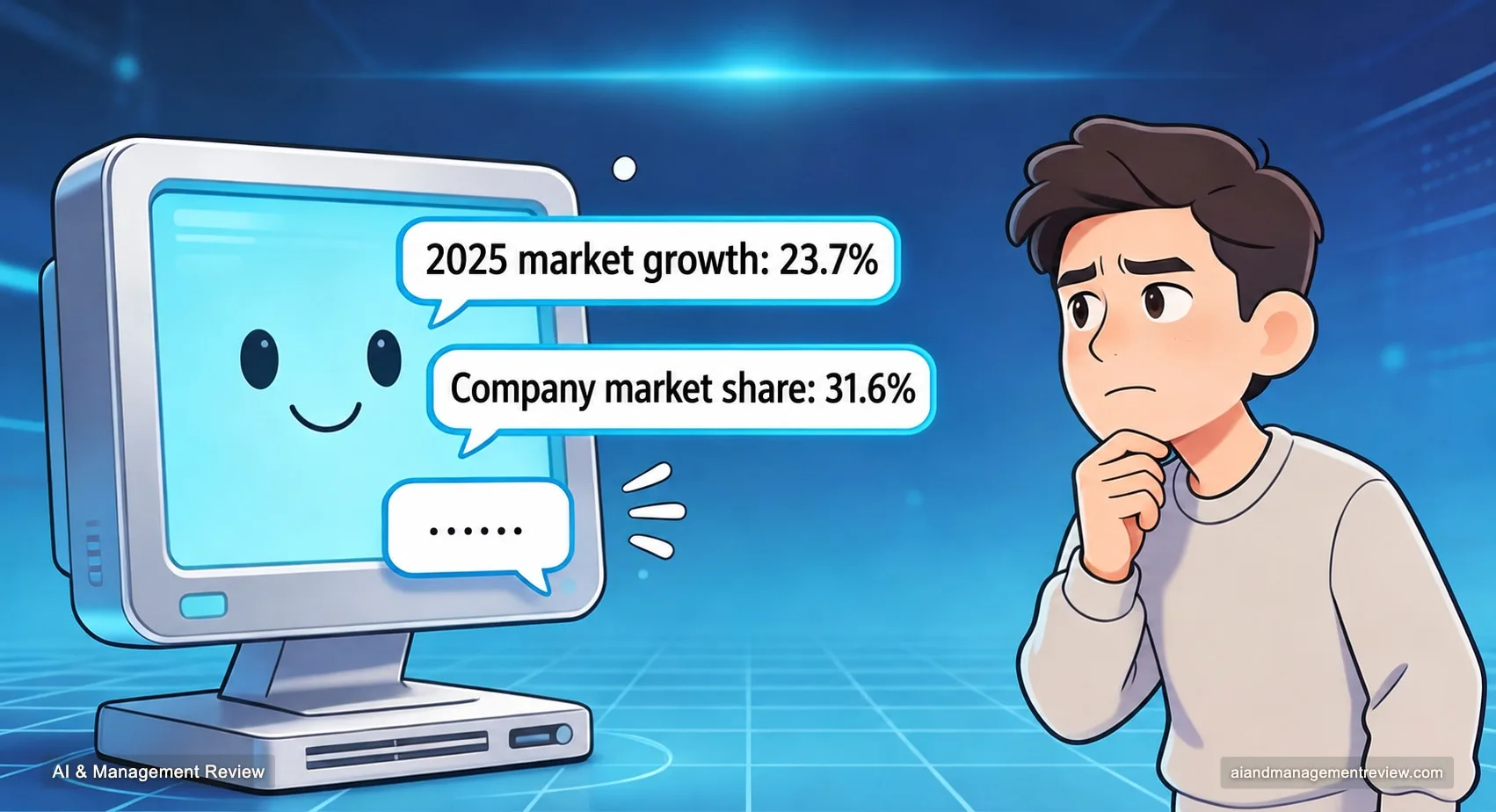
On this page
Have you ever had this happen?
You ask AI to help produce an industry analysis. It gives you not only a clear framework but a collection of precise figures: “The market will grow by 23.7 percent in 2025.” “A leading company holds a 31.6 percent market share.” The sources are listed neatly. You take the report into a meeting, use it in a proposal, or even place it in materials for a business leader, investor, or client. Everyone looks at it and thinks it seems credible enough.
Then you check the original sources yourself. The cited reports do not exist, and the figures do not match the real data. AI has fabricated something that looks more real than reality.
Do not dismiss this as an occasional error caused by immature technology. The truth is harder to accept: AI will not merely mislead you from time to time. It will inevitably mislead you. The problem is not its attitude. It is how the system works.
AI has no malicious intent. It can simply generate content that is false but looks true—a phenomenon usually called AI hallucination.
That brings us to the central point: the most dangerous thing about AI is not that it can be wrong. It is that, even when it is wrong, it can look right.
It Looks Like Problem-Solving, but It Is Predicting
You do not need to understand the full technology stack, but two things about large language models matter here: the underlying architecture, known as the Transformer, and the training objective of predicting the next token.
A central capability of the Transformer is its attention mechanism. Put simply, attention helps AI detect relationships among different words in what you say. Compare “This apple tastes great” with “Apple released a new phone.” The attention mechanism helps the model infer from the surrounding words that the first refers to the fruit and the second to the company.
That is why AI can appear to understand your question. But reading context is not the same as verifying facts.
Now consider the training objective. A large language model is trained on enormous amounts of data. If you ask, “How tall is Mount Everest?”, the base model on its own does not first consult an encyclopedia. Instead, it uses patterns across its training material to predict that the number most likely to follow “Mount Everest” is 8,848 meters.
More technically, AI breaks text into small units called tokens and uses the context to calculate which token is most likely to come next.
Its first move is not to verify the facts, reason rigorously, and then organize the answer. Its underlying move is to generate, by probability, the continuation that fits the preceding context most naturally. Whether a manager can sign off on that answer and stand behind it is not something the model is inherently responsible for.
A Smart Assistant Still Fails When Used the Wrong Way
Imagine that you have an assistant.
The assistant has never left the office but has memorized annual reports, financial statements, and press releases from companies around the world. You ask, “What was Company A’s revenue last year?” Instead of checking Company A’s accounts, the assistant recalls the number that appeared most often in texts containing similar keywords.
Most of the time, that number may be correct. But if Company A’s real figure never appeared in the material the assistant read, the assistant may assemble a plausible number from data about other companies—and deliver it with complete confidence. Across everything the assistant has read, that is simply the kind of number that usually comes next in this context.
That is what a large language model does. It appears to answer your question, but underneath, it is continuing the context.
The problem is not that the assistant is unintelligent. The problem is that you have used the assistant in the wrong way. Asking it to draft a report can be useful. Treating it as the sole source of facts is dangerous.
The Standards You Use to Judge People Do Not Work for AI
After leading teams for long enough, you naturally learn to trust a certain kind of person: someone who communicates clearly, reasons carefully, provides rich detail, and remains composed under questioning. In management, those qualities usually signal dependability.
With AI, however, those signals will often mislead you.
Large language models are exceptionally good at producing language that is coherent, plausible, and convincing. Fluency and truth are not the same thing. A wrong answer can be generated with extraordinary smoothness.
Worse, AI is especially good at imitating the very signals managers associate with reliability: structure, logic, data, proactive next-step recommendations, and complete answers to follow-up questions.
If you use the standards for judging people to evaluate AI, the result is a paradox: the more trustworthy AI feels, the more cautious you should be.
That does not mean your judgment is poor. It means you are applying the right standard to the wrong object. Working with AI requires a new framework for deciding what to trust and what not to trust. The first rule is simple: do not evaluate AI’s claims the way you evaluate a person on your team.
This Is the Cost of the Technical Approach
You have hired an assistant who never sleeps and has read nearly every book in the world. The price is that the assistant will occasionally invent facts with complete confidence.
This is not simply a sign that the technology is not good enough. It is a tradeoff in the technical approach itself. Buying a sports car and expecting exceptional fuel economy makes little sense. In the same way, choosing the broad coverage and low marginal cost of a large language model means accepting a tradeoff in verifiable factual accuracy. The technology will improve, and hallucination rates will fall. But as long as the system remains generative, management cannot remove the fact-checking gate. The goal is not to wait for hallucinations to disappear. It is to learn how to work with them.
Hallucinations do not come only from probabilistic prediction. The attention mechanism, context window, and temperature setting can all affect what AI sees, what it retains, and how consistently it generates an answer.
So do not expect one or two settings to turn hallucinations off. From a management perspective, assume they will occur.
What to Do: A Three-Layer Framework
If AI will inevitably mislead you, how do you decide which parts of its output to trust?
When a team submits AI-assisted work, first ask which layer it belongs to.
I generally divide AI output into three layers:
- The expression layer—structure, tone, and wording. Use it freely. AI is genuinely strong here.
- The judgment layer—analysis, reasoning, and recommendations. Review it through your own business experience. AI can offer ideas, but the decision remains yours.
- The fact layer—numbers, sources, dates, laws, names, and company information. Verify it independently. This is where fabricated details can appear most freely.
Three categories deserve particular caution:
- Precise figures. Financial data, statistics, and exact dates. AI is good at “approximately”; it is not good at “exactly.”
- Citations. AI can invent entirely plausible paper titles and author names. The citation it produces and the passage it writes come from the same predictive mechanism.
- Fields you do not understand well. This is the least visible trap. If you do not know the field, you cannot cross-check the answer—and AI can fabricate most freely where you are least equipped to notice.
One final red line: if an AI-generated claim cannot be verified through another independent source, do not use it as fact.
Management Advice
AI can enter the workflow, but it should not enter the decision chain unchecked. Every fact that appears in a report, contract, budget, campaign, or external communication should be confirmed by another independent source. Without verification, even the most fluent output is still only a draft.
The more finished an AI-generated deliverable looks, the more deliberately you should treat it as a work in progress. When the business leader asks the final question, it will not be “What did AI say?” It will be “How did you verify it?”
Next time, we will use management thinking to crack open another AI question.