EssayOrganization and Management in the AI Era
Don’t Just Make AI Follow You—and Don’t Just Follow AI
People can become trapped in a frame proposed by AI, while AI can become trapped in assumptions supplied by people. Important proposals need a two-way guardrail that reviews both the answer and the brief.
Original Chinese version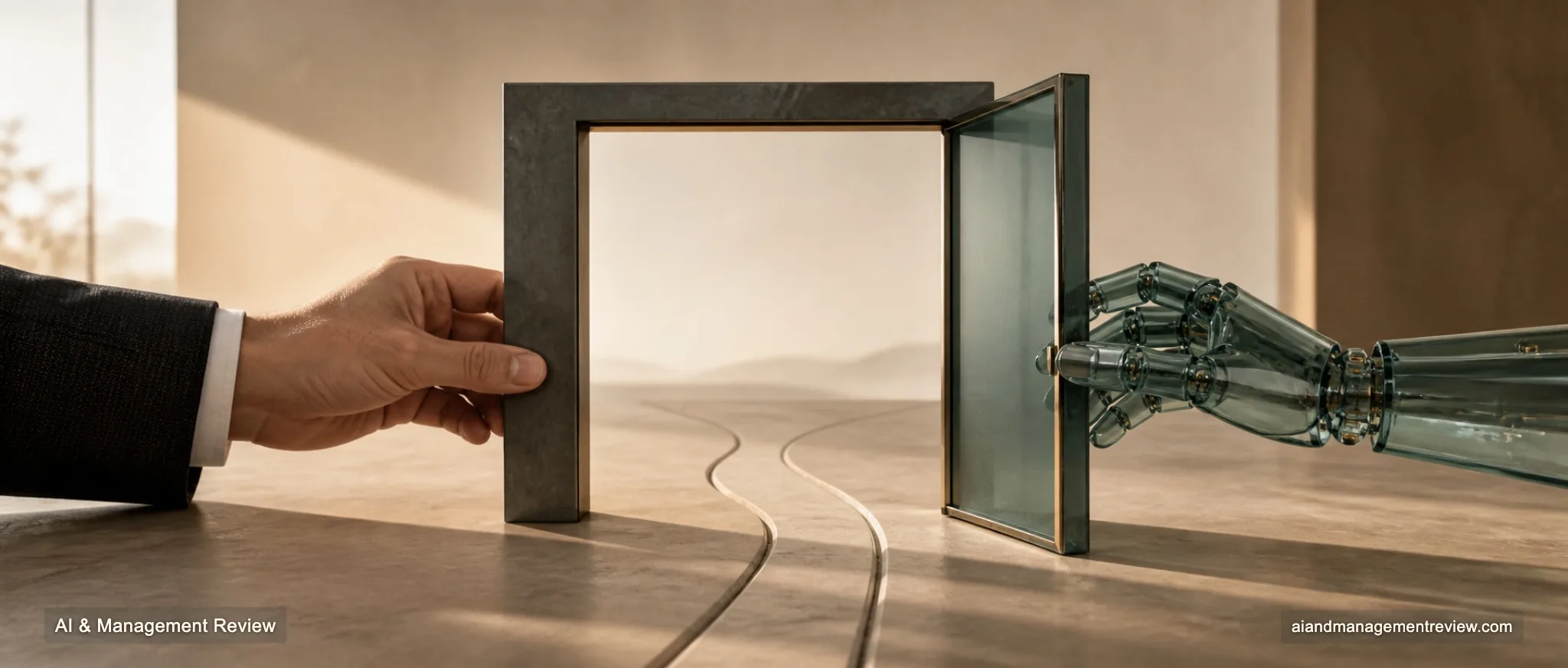
Your company has spent heavily on an AI system. The team is genuinely using it. Every week brings another meeting and another revision. The proposals look more polished each time. Yet something still feels wrong. The work appears complete, but the direction never feels quite convincing.
Imagine that customer renewal is declining and you ask the team to find a solution. They give the problem to AI: renewal keeps falling; analyze the causes and propose a response. AI quickly produces a frame. It segments customers, designs several tiers of discounts, and lays out a detailed promotion plan. The team sees a complete answer and asks AI to keep refining it—to tune the model and improve the execution details.
The reverse happens as well. Sometimes the team begins by deciding that price is the problem and discounts are the answer. They ask AI to build a promotion plan and add a long list of requirements: protect gross margin, consider the service experience, and account for the sales cycle. AI accepts every instruction and turns them into a more comprehensive discount program. The result covers everything—except an alternative to discounts.
These two situations are the same at their core. Whoever moved first, the “discount” frame entered the discussion early. After that, no one stopped to ask whether it was the right frame. AI proposed a frame and people refined it. People proposed a direction and AI filled it out. Both sides worked diligently, but neither stepped back to examine whether the frame itself deserved to survive.
The problem is not that AI is inadequate or the team is careless. A step is missing. No one is reviewing the frame.
Think about the meetings you have attended. How often does the entire discussion form around the first proposal placed on the table? People are usually good at improving someone else’s plan. Far fewer are willing to open a different path. A proposal that seems good enough can drift into collective acceptance simply because nobody objects. A better solution may exist, but no one raises it for comparison.
To be fair, the person who proposes the first direction deserves support. They took responsibility for moving an ambiguous problem toward action. Supporting that progress, however, does not mean treating the first frame as an unquestionable premise.
The same meeting-room pattern reappears inside AI systems for several reasons:
- Give AI a task and a scope, and it will improve the work inside that scope. That is one of its strengths.
- Some large language models tend to continue along the user’s view instead of putting contrary evidence in front of them.
- Research on some multi-turn tasks has observed that a model may commit early to one solution and keep working around it. Additional instructions later in the exchange may not pull it back to reconsider the whole problem.
Employees can be carried forward by AI’s initial frame. AI can be constrained by an employee’s incomplete brief. Both sides keep “improving” the answer while their capacity to analyze and explore remains underused.
A Two-Way Guardrail
How do you correct this? In World War Z, there is a tenth-person mechanism for collective judgment. If the first nine people agree, the system assigns the tenth person the responsibility of challenging the consensus. The point is not to force disagreement. It is to preserve an institutional opening through which a unanimous view can still be examined.
Think of it as placing a guardrail in the decision process—and then take the idea one step further. Make the guardrail work in both directions.
If only people review AI’s output, the organization may catch weaknesses in what AI produced while leaving the human-defined frame untouched. An expensive AI system then remains trapped inside the old mental loops of the people using it.
The process therefore needs two directions of review. In one direction, a person reviews the proposal AI submits: what assumptions does it depend on, is the evidence sufficient, and what other paths deserve comparison? In the other direction, AI is allowed to review the brief people give it: does the premise hold, does the proposed action support the business objective, and is there another explanation that should be tested? People retain responsibility for the review, while AI receives enough room to ask substantive questions.
Return to the renewal example. The person responsible for reviewing the frame begins with one question: does the available evidence actually show that price is the main cause of customer loss? If the team cannot answer, people and AI need to gather more information, identify the primary problem, and only then decide whether to offer discounts or change something else.
The purpose is not to restart every project. If the added evidence supports the original direction, continue. If the problem is limited, adjust only the part that needs adjustment.
Inside the organization, clarify both responsibility and authority. Assign responsibility for reviewing the frame of an important proposal to a specific person; this does not require a new role. Write AI’s right to question assumptions into the collaboration brief as well. AI may ask evidence-based questions and propose alternatives, but it may not change the goal or act beyond its authority. Nor should it challenge for the sake of sounding critical.
When should this happen? Before an important proposal is finalized, or when new information clearly weakens a key assumption. If a proposal has gone through many rounds of revision and still feels unsatisfactory, treat that as a signal. The team may need to stop refining the answer and review the frame.
One final step is easy to forget: a challenge needs an owner. Questions raised by AI must enter the proposal owner’s judgment and receive a response. Do not let the challenge end as another message sitting unanswered in a chat window.
Management Advice
Do not look only at whether the proposal is complete. Put a two-way guardrail into the process so the team can step back and review the direction and AI can question the assumptions in the brief. That is how your investment reaches organizational effectiveness instead of disappearing into an ever more polished stack of revisions.
When you bring a proposal into a meeting, do not submit only a finished answer produced by AI. Show the critical assumptions, the alternatives worth comparing, and the judgments that people and AI challenged and tested together. Make it visible that the proposal did not emerge by letting AI slide along the path of least resistance.
Next time, we will use management thinking to crack open another AI question.